THAT OLD TIME ROCK AND ROLL
David Clayton-Thomas wasn't the most popular singer but was one of a kind

I admit I had a love-hate relationship with Blood, Sweat, and Tears (the name is often written with an ampersand, “Blood, Sweat & Tears”). Back in the day, rockers—-probably way more so than crossover-friendly artists today—-were territorial and highly judgmental. Creedence Clearwater Revival, a highly successful and popular band, nevertheless were viewed by many hard-core rockers as lightweights. Their musical arrangements were plain vanilla, with virtually no chord changes (“Run Through the Jungle” is basically one chord) and fewer surprises. Certainly their “Fortunate Son” carried a meaningful protest mentality (though in the Iraq War era it proved ironic that the children of congressmen served in the military, even in combat, at higher percentages than kids of the ordinary shmoe on the street. But still, when those chords come on, you know the song—-and the meaning.
Likewise, while obviously they had the armies of Dead Heads, the Grateful Dead were often viewed with scorn in the musical circles I traveled. None seemed to be outstanding musicians, and, hey, anyone could write drug lyrics. One could make a similar case for Bob Seeger, a true rocker, who nevertheless seemed too formulaic and pop-oriented, which, of course, is an unfair claim given that I doubt Bob Seeger ever wrote a song just to make money. After all, rock and roll never forgets.
Both Blood, Sweat, and Tears and Chicago came in for different skepticism and criticism. Clearly both bands were talent rich. Too often, however, they relied on musical skill to “trick up” music and take it out of its most basic and appealing groove. And, let’s be honest: except for accents, most guitar rockers viewed horns with disdain. It really took Tower of Power to break the mold. Let’s face it: no one could envision either the horn sections of Blood, Sweat, and Tears or Chicago as backing up Jeff Beck and Rod Stewart.
Don’t get angry with me for explaining the zeitgeist at the time, and certainly I didn’t then, and certainly don’t today, travel in all musical circles. But it’s hard to conceive of Lynnrd Skynnrd, after laying down “Sweet Home Alabama,” saying, “Guys, I think we need some horns.”
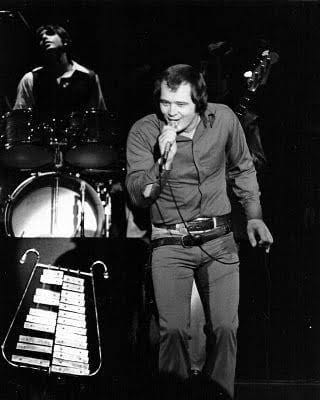
Far more than Chicago, however, which seemed to work in intricate but distracting horn sections to appease that part of the band, Blood, Sweat and Tears seemed to have a more cohesive integration of horns with the traditional rock elements. Perhaps this came from Al Kooper, the blues B-3 player who formed the band. Eventually, Kooper left and David Clayton-Thomas replaced him as the lead singer. BS&T shot up on popularity, even while losing a certain amount of genuine rock feeling. And at the center of that was Clayton-Thomas, who died today. Clayton-Thomas was a Canadian who as a youngster found himself on the streets and afoul of the law. He had a gravelly and distinct voice, unmistakable from the first note. He was a successful writer, penning the band’s #2 hit “Spinning Wheel.” He fearlessly took on soul ballads such as “God Bless the Child.” As one reviewer noted, Clayton-Thomas perfectly understood how to blend in with the horns, not fight against them or seek to relegate them to the background.
Clayton-Thomas once said that he thought the band was out of synch with the industry. Their “Blood, Sweat, and Tears” album came out in 1968, just as Cream—-formed two years earlier but whose “Disraeli Gears” hit hard in 1967, as did “Are You Experienced?” by Jimi Hendrix, “Surrealistic Pillow” by Jefferson Airplane, “Moby Grape” by the band of the same name, “Ten Years After,” the Doors’ first album, Moody Blues “Days of Future Past,” “Buffalo Springfield Again” by Buffalo Springfield, “Their Satanic Majesties’ Request,” by the Rolling Stones, and, of course, “Sergeant Pepper.”
Although the Beatles were experimenting with horns in “Got to Get You Into My Life” a year earlier, and while the Beatles, Stones, and others had used strings in numerous studio recordings, for the most part horns were an after thought except for Chicago and BS&T. No one quite knew what to do with such bands.
“Blood, Sweat, and Tears” album stayed on the charts for over 100 weeks. The catchiness of “Spinning Wheel,” “And When I’m Gone,” and “You Made Me So Very Happy” were instantly recognizable, yet at the same time almost viewed as bubble gum by the hard core rockers who dominated Woodstock in 1969.
My own experience was idiosyncratic, not philosophical. Personally, I liked them (I had loved the BS&T first album). At the time I first listened to the “Blood, Sweat, and Tears” album we were working on installing a pair of headers on my 1969 Super Sport Camaro as I slowly (with a lot of help from real car guys) worked to turn it into a drag racer. Headers are pipes that attach directly to the engine exhaust, then are “capped” by running the exhaust tube into the muffler so that the noise doesn’t get you arrested. To race, you “uncapped” the headers and heard the engine roar.
The headers I was using were designed by the son of one of my deceased father’s friends, a local Arizona racer named Frank Sanders, Jr. The package for the headers promised “Installs in 30 minutes.” Yeah, maybe at Indy. Apparently Sanders never heard of power steering, which placed a box right in the path of where the headers went.
Anyway, on a night I’ll never forget, me and several of my more talented “car guys”—-perhaps five or six of us—-put my Camaro in the front yard and got to work. (My parents were out of town, as I recall). My best friend at the time, J. B. Spears, had a 69 Ford 351 Mustang, a pretty nice car itself, and it had an . . . eight track cassette tape player. So, back in the day, it was a big breakthrough when cars started featuring tape players that used cassette tapes the size of a Zane Grey novel. Hey, you work with what you got. J. B. only had two tapes: “Creedence Clearwater Revival” and “Blood, Sweat, and Tears.” Not a problem right? Installs in 30 minutes.
Except after he ran through both tapes two times, we got the right header on in 10 minutes, but the left header met Mr. Power Steering. That’s when the trouble began, and when my love/hate with Blood, Sweat, and Tears (and Creedence) started. We worked and worked, tried every angle, huffed and puffed. By then it was about 2 a.m. and we had been at it for hours with no success. By about 4 a.m., one of my gang, my long-time friend and band bass player Randy Gage, in exasperation said, “Give me that thing.” He tossed it in his van (as I recall) and we piled in with him. He worked at a local electric motor winding company—-and would later go on to be the CEO of one of the largest electric pump companies in the entire world—-and had the keys to the building. We went inside, where Randy fired up the welder, and proceeded to completely reweld the header pipe in directions that would puzzle an octopus.
Installs in 30 minutes.
Anyway, somehow he got it right on his first try, and with the appropriately re-welded header, we returned and indeed he installed it in less than 10 minutes. But meanwhile, we had listened to the entire “Blood, Sweat, and Tears” and “Creedence Clearwater Revival” albums probably 50 times. When the night was done, honestly, I couldn’t stand either band for many, many years.
Thomas left the band, then returned, then toured with other variations of the band, then did more solo albums. I will admit, aside from his work with “Blood, Sweat, and Tears” I am not familiar with most of his other songs.
Nevertheless, his comment about being out of synch with the industry—-which I heard maybe 40 years later—-struck me as absolutely accurate. Modern music, once you flush out all the pop production and AI and forced crossovers, is nevertheless much more willing to ignore where you came from and instead only ask, “Can you make me money?” I think had an iteration of Clayton-Thomas and BS&T come along in the 2020s, they would have had a much longer run.
Not sure I can say the same for Creedence.
RIP David Clayton-Thomas.
NEW: Buy Larry a “Crypto Coffee”! Use crypto for your coffee tips.
Larry Schweikart (@CyberneticsLS on Truth, @LarrySchweikart on X)
Rock drummer, Film maker,NYTimes #1 bestselling author
Link for Patriot’s History Vimeo
Link to buy larry a coffee
http://buymeacoffee.com/larrys
Nice story. Thanks for sharing your memories. The irony is that, the band is more likely to be good if it has a saxophone and a stand up Bass.